The System Design Sniper Shot
System design interviews are a special kind of performance art. You walk into a room (virtual or physical) and someone, with an unnerving smirk, says something deceptively simple. "Design a URL shortener." You, with the confidence of someone who has read the first chapter of Grokking the System Design Interview, immediately sketch a key-value store and a hashing function. Nailed it. ...until the interviewer begins their interrogation. "What about distributed analytics? Rate limiting? Geo-routing? Abuse detection? Oh, and it must have custom domains. What did you think we were talking about, a pet project for your cousin's dog grooming blog?" Welcome to the hidden requirements trap. Every interview: The question is a trailer; the actual movie is a six-hour, director's-cut IMAX disaster. Today, we're not just going to talk about that conversation. We're going to give you the blueprint, the actual architectural diagram of that "distributed analytics platform with link management as a feature" that they meant but didn't ask for. Grab your coffee. This is going to get distributed.

What They Said vs. What They Meant: The Architecture Diagram
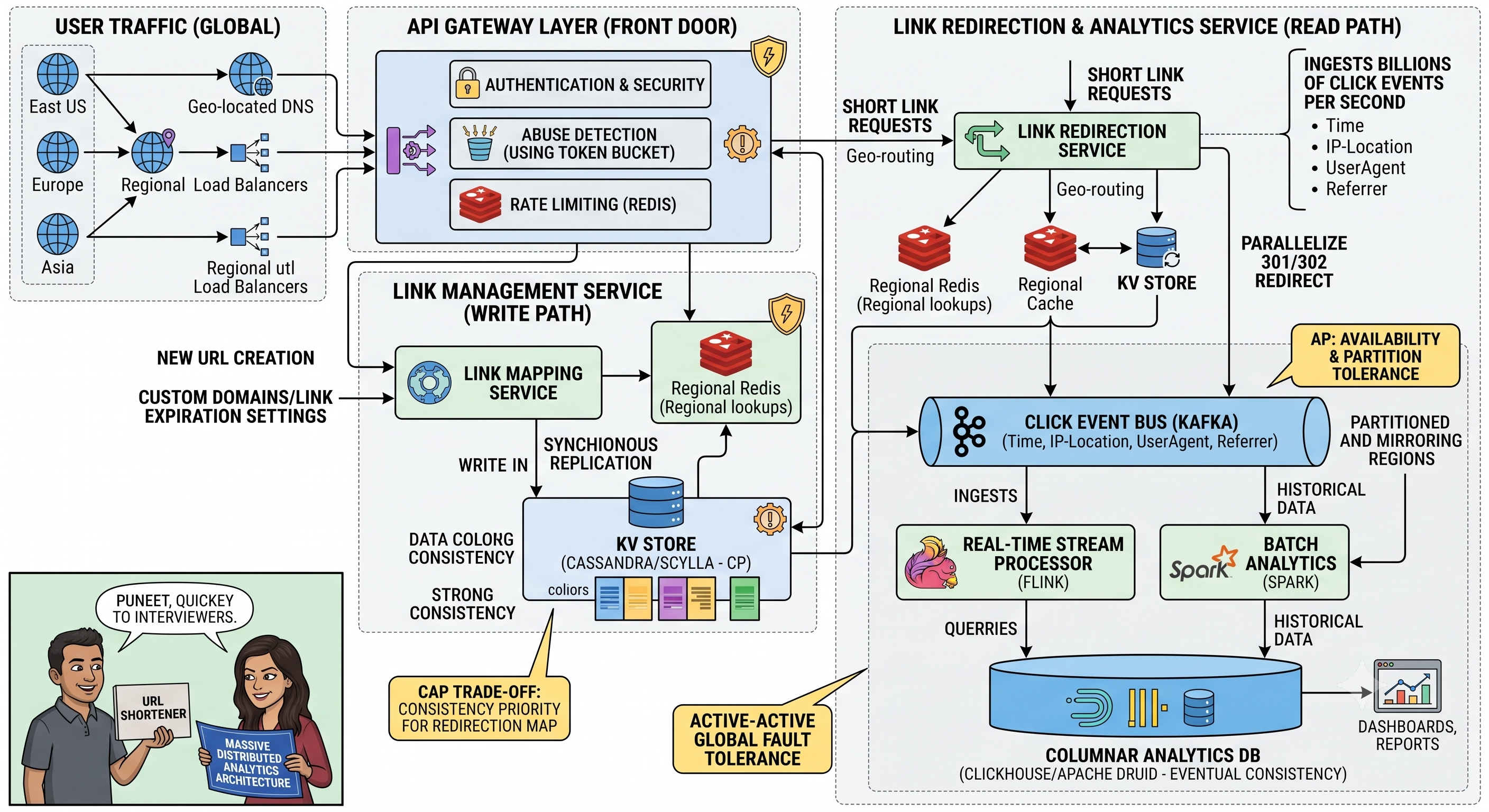
You can't just draw a single database and call it a day. This is a system built for massive scale, deep metrics, and bulletproof availability. Here is the actual system design you need to discuss.
This diagram contrasts what the simple request is vs. the massive, fault-tolerant analytics system that actually solves the unstated problem. Let's break down the data flow.
Decrypting the Data Flow
In this full-scale distributed platform, the data doesn't just flow; it cascades, replicates, and is simultaneously processed for multiple purposes. Here is how that complex diagram works in a live system:
The Gateway & Security Layer (Abuse & Rate Limiting)
A user clicks a short link (t.ly/XyZ). The request hits an API Gateway. The hidden requirement here is Abuse Detection and Rate Limiting. The gateway doesn't even talk to the Link Service yet. It queries a Redis cache or dedicated rate-limiting service (e.g., using Token Bucket or Leaky Bucket algorithms) to ensure this isn't a DDoS attack or an excessive bot. If it's malicious, we drop it. Simple and effective. (Visually: The API Gateway -> Rate Limiter -> Abuse Detection icons.)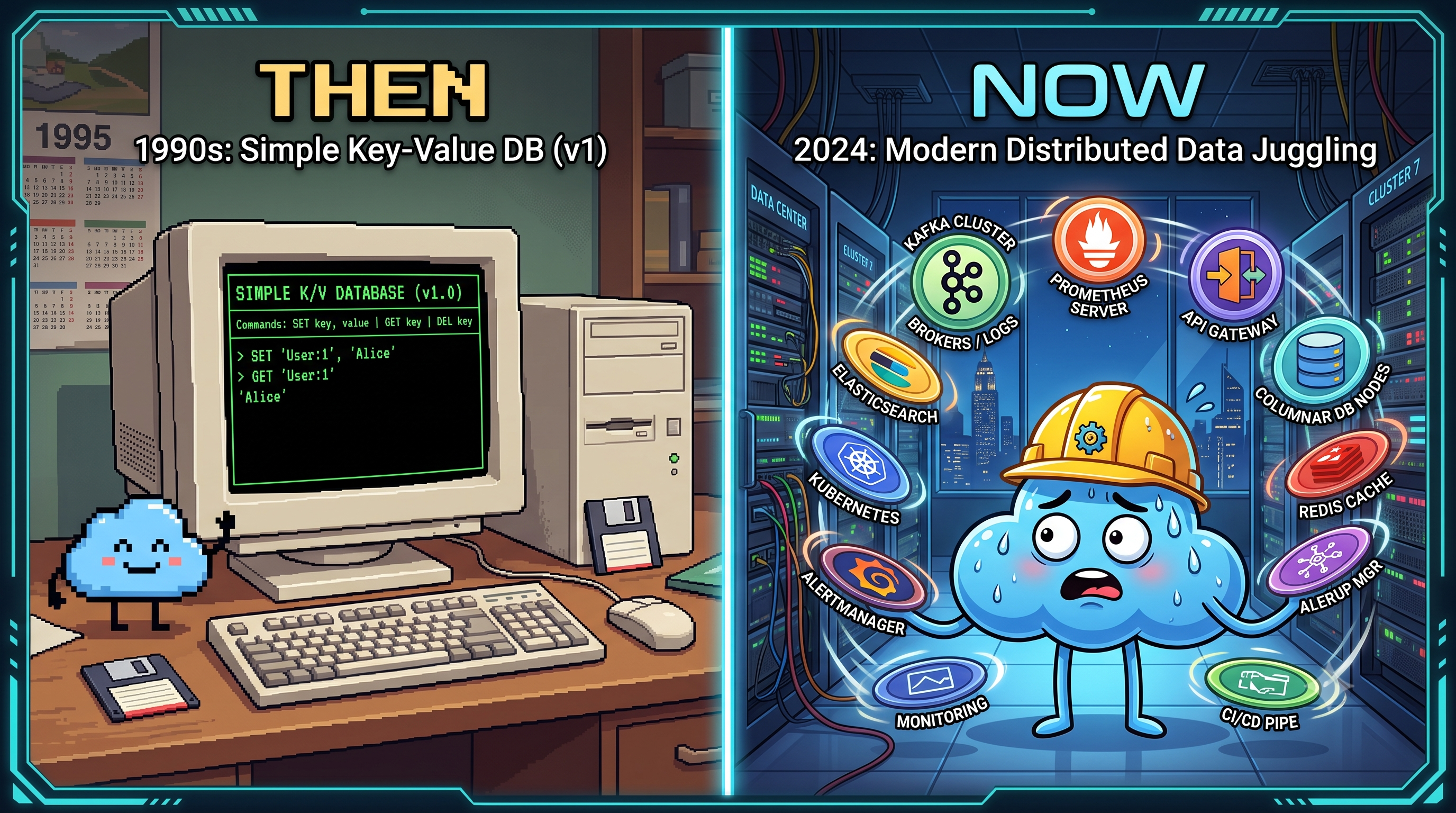
Geo-Routing (Where in the World?)
The interviewer mentioned Geo-routing. If we have regional datacenters, the request shouldn't travel across continents. This diagram uses a Global Load Balancer to perform Geo-routing, directing the request to the regional cluster closest to the user. (Visually: Global LB -> Globe Icon.)The Critical Path: Link Redirection (The CP Problem)
Now we are in a regional cluster. The Regional Load Balancer sends the request to the Link Management Service. This is the service that makes the actual decision: where does t.ly/XyZ go? This is where the Consistency vs. Availability (CAP) trade-off is crucial. For redirection, accuracy is everything. We cannot allow a link to look expired to one user but active to another, nor can we direct to the wrong long URL. This specific part of the system is designed with a strong focus on Consistency (C) and Partition Tolerance (P).
CAP applied here (CP): The mapping database (e.g., a clustered Redis or a carefully configured Cassandra/Scylla) uses strong consistency principles (e.g., synchronous replication or a high read/write quorum). We trade off some availability (a single node failure might make some links briefly unwriteable) for the guarantee that the short-to-long mapping is always correct. If the system cannot guarantee the mapping is consistent, it fails the request rather than giving stale data. (Visually: Link Service -> K-V Store, with the 'CP' triangle.)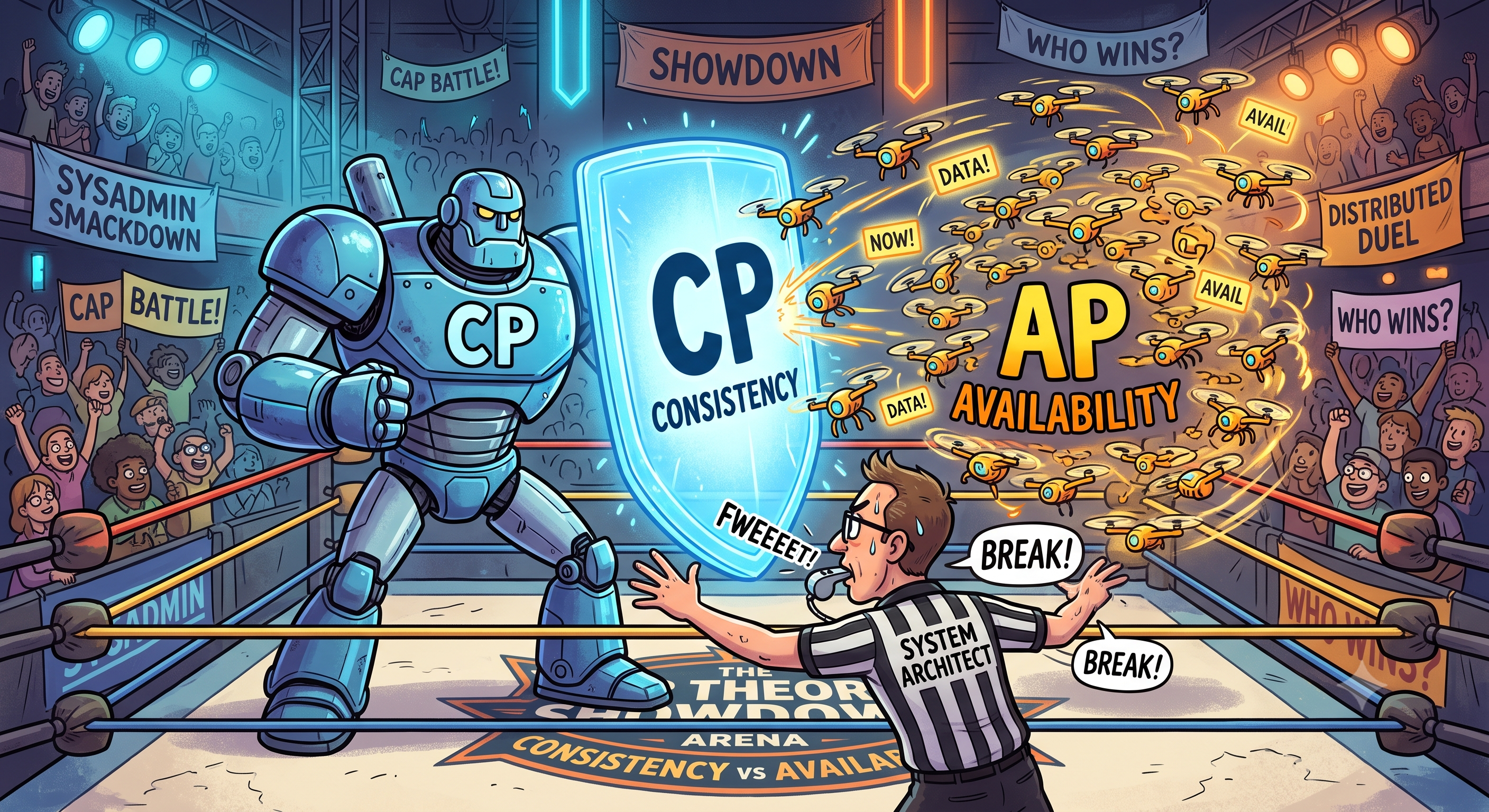
The Real Goal: Distributed Analytics (The AP Problem)
The interviewer didn't really want a shortener; they wanted a massive, real-time analytics engine attached to a shortener. The moment the Link Service determines the target URL, it performs two separate operations simultaneously: Operation A: It instantly returns the HTTP 301/302 redirection to the user. Minimal latency is the priority. Operation B: It sends a highly detailed click event (time, user agent, IP-based location, custom domain, referrer) to a distributed messaging queue (e.g., Click Event Bus, typically Kafka). CAP applied here (AP): This part of the system is optimized for massive ingest and data availability. We prioritize Availability (A) and Partition Tolerance (P) for the analytics pipeline. We don't need absolute real-time, strong consistency for our charts. If one Kafka broker is down, we immediately fail-over to another. It's okay if a real-time chart is slightly behind (eventual consistency) as long as we never lose a single data point and the ingest doesn't halt. (Visually: Click Event Bus -> Real-time Processor -> Columnar DB, with the 'AP' triangle.)Fault Tolerance & High Availability (Regional Failover) You can't have a 1M requests/sec system that goes down when a server gets tired. Component-level Failover: Look at the diagram. There are multiple nodes for everything. Multiple API gateways, multiple database nodes with active replication. If one fails, another takes over instantly. Regional Failover: The diagram highlights an 'Active-Active Global Fault Tolerance'. If a whole regional datacenter goes dark (e.g., a massive power outage), the Global Load Balancer instantly detects this and redirects all incoming traffic to the 'Standby Regional Cluster'. (Visually: Large 'Active-Active' dashed box failover connection.)

This is the system they want you to design. The one that handles geo-redundancy, rate limiting, abuse detection, AND ingests billions of events per second with AP-level availability, all while performing CP-level consistent redirection.
When your interviewer asks for a URL shortener, give them a glimpse of the five-star, multiplex, distributed masterpiece they actually want. That's how you nail the conversation.
#SystemDesign #Architecture #TechInterviews #URLShortener #DistributedSystems #FaultTolerance#HighAvailability #CAPTheorem #ConsistentHashed #EventualConsistency